In this article
If you think your cat is fine just sleeping 16 hours a day, you're not wrong — but those other 8 hours matter more than you think. Indoor cats need physical and mental stimulation to stay healthy, happy, and out of trouble. Without it, they get bored, gain weight, and sometimes develop behavioral issues like scratching furniture or knocking things off tables (okay, they might do that anyway).
HOW MUCH PLAY DOES A CAT NEED? — Cats need at least 1 hour of active play every single day. That might sound like a lot, but here's the secret: you don't need to do it all at once. In fact, cats are built for short bursts of intense activity, not long marathons. Think of how a wild cat hunts — sprint, pounce, rest, repeat. Your cat's play should mimic that natural rhythm.
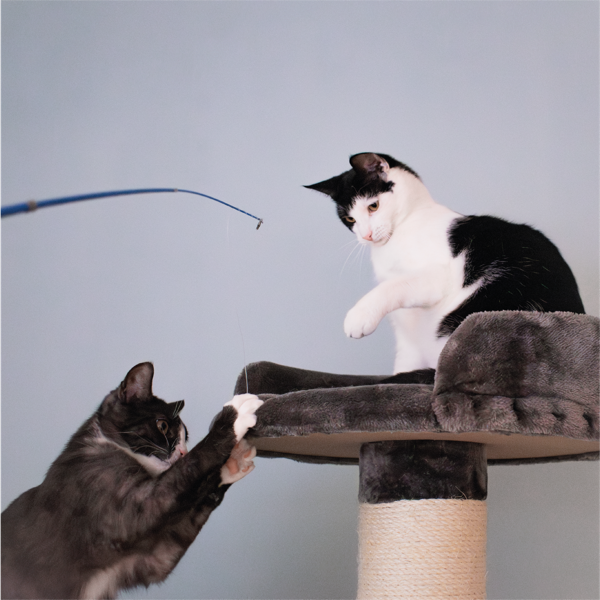
TIP 1: THE 15-MINUTE INTERVAL METHOD — Instead of one long play session, break it into four 15-minute sessions spread throughout the day. Morning, lunchtime, afternoon, and evening. This matches your cat's natural energy peaks. Cats are most active at dawn and dusk (crepuscular animals), so schedule your biggest play sessions around those times. Even just 15 minutes of intense wand toy play will leave your cat panting and satisfied. The key is intensity — make those 15 minutes count. Sprint, jump, chase. Let your cat go all out.
TIP 2: MAKE MEALTIME A CHALLENGE — One of the best ways to exercise your cat's body and brain is to make them work for their food. In the wild, cats spend hours hunting for every meal. At home, food just appears in a bowl — no effort required. That's boring for a cat. Try food puzzles — containers that make your cat paw, push, or roll to get the food out. You can buy puzzle feeders or make your own from a muffin tin with balls on top, a cardboard box with holes cut in it, or kibble scattered around the room for a 'treasure hunt.' Start easy and increase the difficulty as your cat figures it out. The mental workout is just as tiring as physical exercise.
Perhaps your neighbor could help you play with your cat as well! Not everyone has the time for four play sessions a day — and that's okay. CatChat.social will help you find cat-loving people nearby who would genuinely enjoy spending time with your cat. Someone who loves cats might be the perfect play partner for your furry friend while you're at work or away for the weekend.
TIP 3: THE HUNT-EAT-SLEEP CYCLE — This is the golden rule of cat play, and it's how nature designed cats to live. In the wild, a cat hunts, catches prey, eats, grooms, and then sleeps. You can recreate this cycle at home perfectly. Play intensely with your cat using a wand toy — let them stalk, chase, and 'catch' it. This is the hunt. After 10-15 minutes, when your cat is panting slightly, it's time for the catch. Let them grab the toy and 'win.' Then immediately serve their meal. This is the eat. After eating, your cat will naturally groom and then fall into a deep, satisfied sleep. This cycle is the single most effective way to exercise and satisfy your cat. Playing right before their big meal is the best way to activate their hunting instincts and then reward them. Your cat will be calmer, happier, and sleep better.
TIP 4: CREATE VERTICAL ADVENTURES — Cats love to climb. It's in their DNA. Even in a small apartment, you can create vertical space with cat shelves, window perches, and cat trees. A tall cat tree near a window gives your cat exercise (climbing up and down) plus entertainment (watching birds and street life). If you're handy, install wall-mounted shelves at different heights so your cat can make a circuit around the room without touching the floor. This is especially important in multi-cat households — vertical space reduces tension because cats can claim different levels as their territory.
TIP 5: ROTATE TOYS LIKE THEY'RE NEW — Cats get bored of the same toys, just like kids. But here's a trick: instead of buying new toys constantly, rotate them. Keep 3-4 toys out and put the rest in a drawer. Every few days, swap them. When a 'forgotten' toy reappears, your cat treats it like a brand new discovery. The best cat toys are simple: wand toys with feathers (mimics birds), crinkle balls (mimics prey sounds), laser pointers (for sprint exercise — always end with a physical toy so they get the satisfaction of 'catching' something), and crumpled paper balls (free and surprisingly entertaining).
BONUS: THE POWER OF ROUTINE — Cats thrive on routine. If you play at the same times every day, your cat will start anticipating it — you'll see them waiting by the toy drawer, ready to go. This anticipation is itself a form of mental stimulation. A predictable play schedule also helps with behavioral issues. Many 'bad' cat behaviors — like 3 AM zoomies, excessive meowing, or scratching furniture — are simply signs of a bored, under-exercised cat. Give them proper play, and most of these behaviors disappear.
Remember: a tired cat is a happy cat. And a happy cat makes for a happy home. If you're a cat sitter on CatChat, knowing how to play with cats properly is one of the most valuable skills you can have. Owners will love you for it — and the cats will too.
Join the CatChat Community
Free cat sitting, real friendships, and a community that cares about cats as much as you do.
Join CatChat — It's Free 🐾Trusted Sources
Related Articles